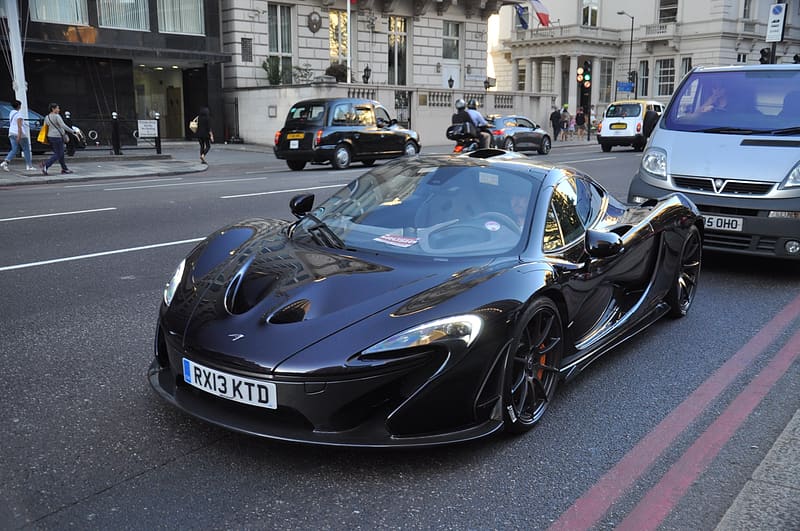
The second car in McLaren’s Ultimate Series after the F1, shown as a concept at the 2012 Paris show and in production form at Geneva in 2013. Styled by Frank Stephenson, it pairs a 3.8-liter twin-turbo V8 with an electric motor for 903 hp, and uses a Formula 1-style drag reduction system on its active rear wing. 375 were built between October 2013 and December 2015.
How to spot one
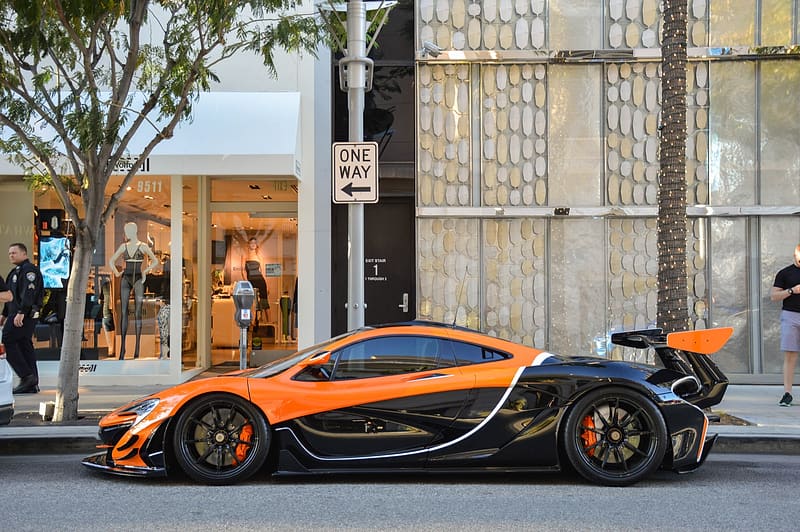
Road P1s have an active rear wing that rises from the tail; the track-only P1 GTR and Lanzante’s conversions wear a large fixed wing, and Lanzante’s P1 GT and GTR-18 also have a longer tail.
A McLaren Special Operations version of the P1, unveiled at the 2016 Geneva Motor Show. Its body is hand-laid carbon fiber finished in a Lio Blue tinted lacquer, the cabin is retrimmed in carbon black Alcantara with contrasting blue stitching, and the exhaust heat shield is 24-carat gold.
How to spot one
A blue-tinted bare-carbon body on gloss black wheels.
A road-legal P1 GTR developed by Lanzante Motorsport, which had McLaren Special Operations build six new GTRs for the project: five were sold and the sixth, the prototype XP1 LM, was kept. Lanzante enlarged the V8 to 4.0 liters for 986 hp with the electric motor and cut 60 kg compared with the GTR. In 2017 XP1 LM lapped the Nürburgring in 6:43.22, beating the road-car record time.
How to spot one
It looks like a P1 GTR but has a modified rear wing, a larger front splitter and dive planes on the nose.
Six more road-legal conversions of the track-only P1 GTR by Lanzante Motorsport, announced in April 2020. They use the longtail bodywork of Lanzante’s P1 GT.
How to spot one
A longer tail, a modified rear wing, a larger front splitter and louvers; the first car wears the “Gulf Team Davidoff” no. 028R livery of a McLaren F1 GTR, with orange wheels.
A Lanzante special based on the P1 GTR, shown at the 2018 Goodwood Festival of Speed. Two were built, for McLaren VIP customers in the United Arab Emirates and Japan, as a tribute to the McLaren F1 GT homologation special of the 1990s.
How to spot one
A longer tail, a bigger rear wing, a longer front splitter, vented front fenders, no front canards and four exhaust outlets instead of two; the car shown was Silverstone green like the original F1 GT prototype.
Lanzante's road-legal P1 with the look of the track-only P1 GTR. The name comes from the High Downforce Kit McLaren fitted to a few F1 road cars in the 1990s; Lanzante, the British firm that ran the F1 GTR that won Le Mans in 1995, says it will build nine, one for each F1 HDK. It starts with a customer's road P1 and replaces every body panel but the hood: the car comes out wider, with the P1 GTR's fixed rear wing on carbon pylons instead of the road car's active wing, a deep front splitter, louvered front fenders and high-mounted GTR mirrors, and the suspension is retuned for the extra downforce. Owners can add a 4.0-liter V8 built with Cosworth for about 1,000 hp, against 903 hp for a stock P1. The first car was shown during Monterey Car Week in August 2021. Chassis 003, in Cherry Bomb Red with black stripes, sold for $3,575,000 at Mecum Monterey in August 2026.
How to spot one
A road P1 with license plates and the P1 GTR's big fixed wing standing on two swan-neck pylons. Then check the front fenders: rows of slatted louvers on top of both, which a P1 LM or P1 GTR doesn't have. Add a deep splitter that sticks out past the nose and mirrors on stalks; several have a tall roof scoop and five-spoke silver wheels like an F1 GTR. A stock P1's wing rises out of the tail on struts and lies flat when parked; the P1 GTR has the fixed wing but slicks, a race livery and no plates.
A track-only P1 built to mark 20 years since McLaren’s 1995 Le Mans win, shown as a concept at Pebble Beach in 2014 and in production form at Geneva in 2015. It was first offered only to P1 owners, and McLaren Special Operations built, maintained and ran the 58 cars. Its hybrid V8 makes 986 hp and it is 50 kg lighter than the road car; Lanzante later converted 27 for road use.
How to spot one
A large fixed rear wing, a lower fixed ride height and racing slicks, where the road P1 has an active wing.
Most spotters just write “P1”, and those count as the standard P1. These have a clue in the description that says otherwise, or a spotter’s question, and wait in Help identify: when three spotters agree, the spot gets its variant.
 Very rare