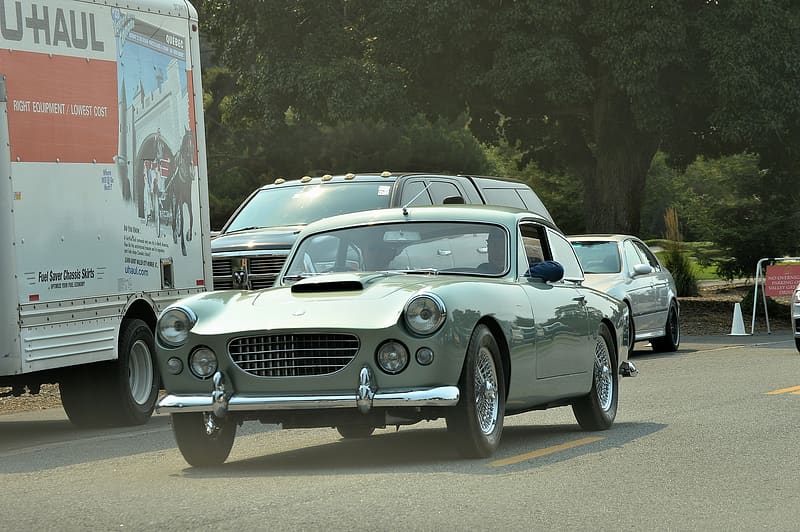
After its last 2-Litre saloon left Thames Ditton in 1958, AC had no car with more than two seats. Encouraged by its Swiss importer, the racing driver Hubert Patthey, AC's chief engineer Alan Turner designed a four-seat GT coupe. A prototype ran at an AC and Lagonda Owners Club sprint at Brands Hatch, and the first production car was shown at the London Motor Show in October 1959, priced at £2,891 (about $8,100). The name came from the greyhound mascot that had stood on the hoods of most prewar ACs.
The Greyhound used the Ace and Aceca's tubular ladder frame with the wheelbase lengthened 10 inches to 100 inches, changed to square-section tubes by 1960, under a hand-formed aluminum body. Unlike the Ace and Aceca, which had transverse leaf springs, it had independent coil-spring suspension at each corner, with semi-trailing arms at the rear, rack-and-pinion steering and front disc brakes. Buyers could choose AC's 75 hp 2.0-liter six, Bristol's 2.0 (125 hp) or 2.2-liter (105 hp) sixes, or, late on, Ford's 2.6-liter Zephyr six tuned by Ruddspeed. Most had the Bristol engine; only six had AC's own. The Motor timed a Bristol 2.0 car at 110 mph and 0–60 mph in 11.4 seconds in 1961, when it cost £3,185 with taxes (about $8,900).
It did not sell. The Aston Martin DB4 had arrived in 1958, and Classic and Sports Car's Martin Buckley wrote that AC "didn't know if they wanted a sports car or a saloon." Plans for other engines, including a Daimler 2.5-liter V8, came to nothing, and from 1962 the Cobra took over the factory and the firm's efforts. 83 were built by 1963, only three with left-hand drive, and fewer than ten are thought to be in the US. The auction record is £82,500 (about $105,000) in 2019; recent sales run from about $57,000 to $83,000.