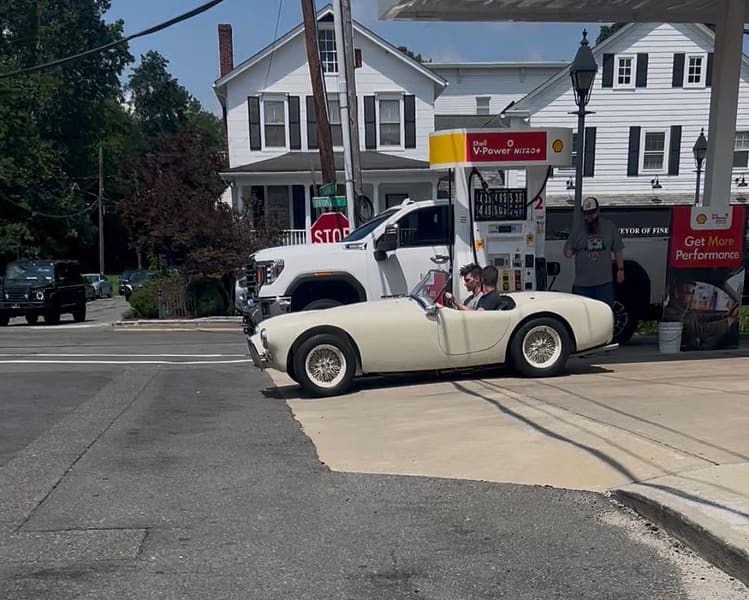
AC needed a replacement for its aging 2-Litre, and in 1953 it bought the design of John Tojeiro’s sports-racer: a ladder frame of large steel tubes, independent transverse-leaf suspension at each corner and a hand-formed aluminum body on a light tubular frame, its shape said to have been inspired by the Ferrari 166 MM barchetta. It went on sale as the Ace with AC’s own 2.0-liter overhead-cam six, a design dating back to 1919, of 85 hp at first and later 90 and 102 hp. The Motor timed it at 103 mph and 0–60 mph in 11.4 seconds in 1954. It cost £1,439 (about $4,030). The Aceca coupe followed in 1954: a fastback with a timber-framed aluminum body and a lift-up rear window, the second hatchback after the Aston Martin DB2/4.
From 1956 AC offered Bristol’s 2.0-liter pushrod six, descended from the prewar BMW 328’s, with 105 to 128 hp; the Ace Bristol cost 22% more and became the most built Ace. Front disc brakes were optional from 1957 and standard from 1958. Ken Rudd, a Worthing engineer, won the 1956 Production Sports Car Championship in his Bristol-engined Ace; works Aces finished seventh and eighth at Le Mans in 1958, and in 1959 Ted Whiteaway and John Turner were seventh overall and won the 2-liter GT class.
When Bristol’s six was coming to an end, Rudd tuned Ford’s 2.6-liter Zephyr six (“Ruddspeed”) in stages, the strongest giving 170 hp. The Ford engine sat lower, so AC lowered the hood and fitted a smaller grille, the nose later used on the Cobra. Only 37 Ace 2.6s and 8 Aceca 2.6s were built from 1961, as Carroll Shelby’s Cobra took over: AC fitted a Ford V8 into an Ace 2.6 chassis, CSX2000, the first Cobra, in 1962, and the Ace and Aceca ended in 1963. About 726 Aces and 328 Acecas were built. An Ace Bristol sold for $280,951 in 2019 and an Ace 2.6 for $500,000 in 2021.