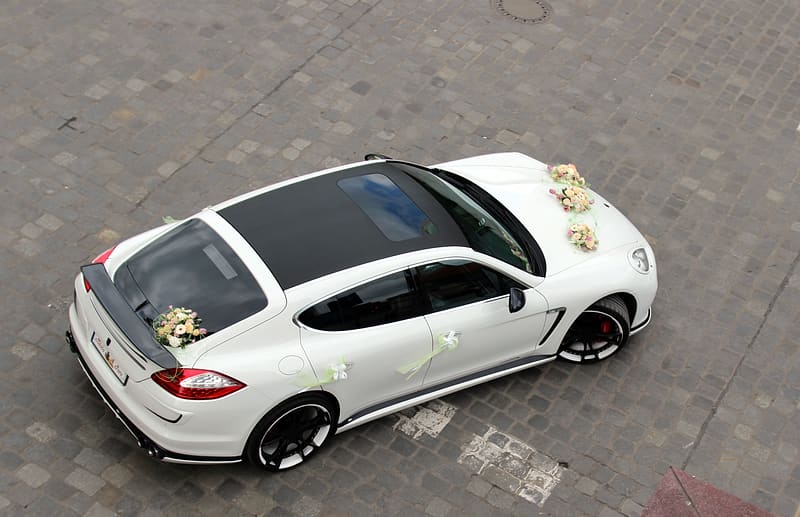
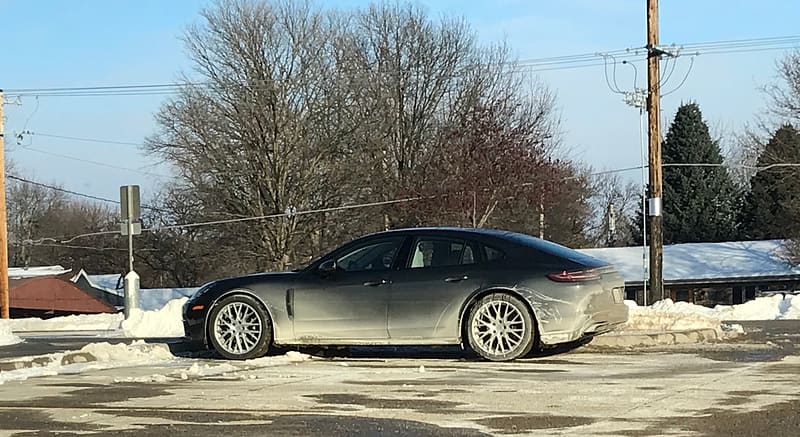
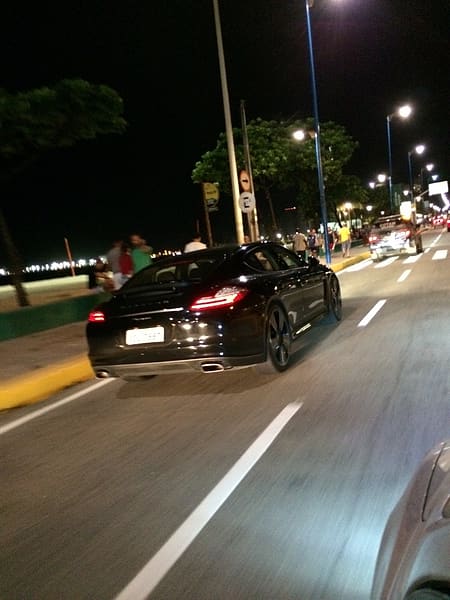
Porsche Panamera

Porsche’s four-door, four-seat luxury sports sedan, built in Leipzig since 2009 and now in its third generation.

Common· 10 pts2009–PresentIn production235,000 built18 variants
Porsche Panamera
Built235,000by 2019
Years2009–PresentIn production
Price new$90k2009 · US price of the Panamera S, the cheapest of the three launch models, when US prices were announced in February 2009 for an October 17, 2009 on-sale date (Porsche release via Flatsixes; AutoGuide). The 4S was $93,800 and the Turbo $132,600.
Value today$20k–$55kRecent prices
Power348–771 hpBy version
0–60 mph2.8 sQuickest version
Top speed204 mphFastest version

Every Panamera

18 variants, by generation: what each one is, and how to tell it apart on the street.

970

2009–2016 · 3 variants · 5 spots
Common

970 Panamera

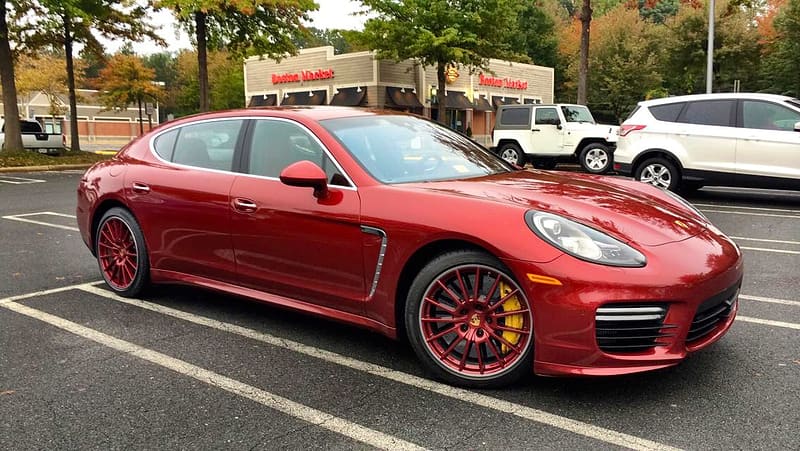
2009–2016 · 395 hp

Every first-generation Panamera below the Turbo. At launch in 2009 there were the S (rear-wheel drive) and 4S (all-wheel drive), both with a 4.8-liter V8 of 400 PS (395 hp); Porsche quoted 0–60 mph in 4.8 seconds for the 4S. The 3.6-liter V6 Panamera and Panamera 4 (300 PS, 296 hp) followed for 2011, as did a 380 PS (375 hp) S Hybrid with a supercharged V6 and an electric motor; a 250 PS (247 hp) diesel was also offered. The GTS, shown in Los Angeles in November 2011, got a stronger 4.8-liter V8 with 430 PS (424 hp), a body 10 mm lower and black highlights. The 2013 facelift moved the S and 4S to a 3.0-liter V6 (420 PS, 414 hp), raised the GTS to 440 PS (434 hp) and the V6 to 310 PS (306 hp), and replaced the S Hybrid with the S E-Hybrid, the first plug-in hybrid in its class (Porsche quotes 416 PS; Wikipedia 422 PS) with about 36 km (22 miles) of electric range. A long-wheelbase 4S Executive was added for China. The last 970 built, in August 2016, was a GTS.

How to spot one

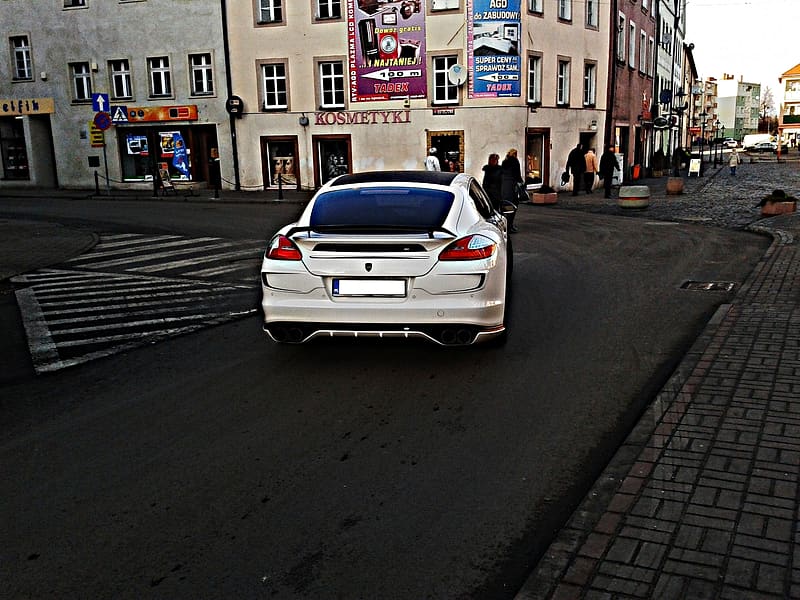
A long, low four-door with a roof that humps over the rear seats and slopes into a big glass hatch; there is no light strip across the hatch (that came with the 971). Facelifted cars (2014 model year on) have larger front intakes, a wider rear window that is more steeply raked, set in a new tailgate, a wider rear spoiler and new head- and taillights, with LED headlights optional. On facelifted cars the V6 models have a one-piece rear spoiler and the V8 GTS a three-piece one. The GTS has black trim; a plug-in S E-Hybrid has a charging flap on the left rear fender.
2 spots · Photos
Common

970 Panamera Turbo

2009–2016 · 493 hp

The top Panamera at launch: a twin-turbo 4.8-liter V8 with 500 PS (493 hp) and 700 N·m (516 lb-ft), all-wheel drive, and Porsche’s claim of 0–60 mph in 4.0 seconds and 188 mph. It came with air suspension, PDCC and a limited-slip differential as standard, and was the only Panamera with the adaptive rear spoiler, which Porsche calls “multi-dimensionally extendable.” It cost $132,600 in the US in 2009. The 2013 facelift raised it to 520 PS (513 hp), and a long-wheelbase Turbo Executive (15 cm longer wheelbase, $161,100) arrived at the same time.

How to spot one

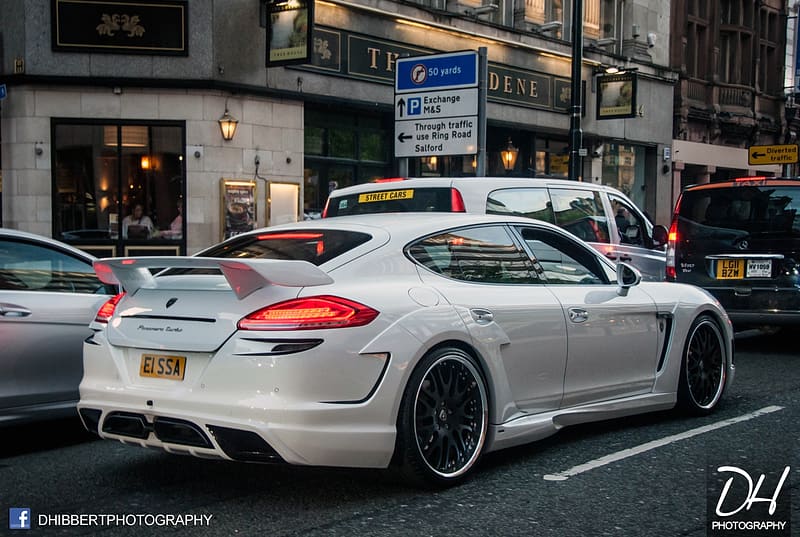
Turbo-only front intakes, a titanium-colored rear diffuser and twin-tube tailpipes, red brake calipers and 19-inch wheels as standard (the S had 18s). Its adaptive rear spoiler rises in steps and extends in several directions (Porsche calls it “multi-dimensionally extendable”); on facelifted cars it is the three-piece spoiler of the V8 models.

2 spots · Photos
Common

970 Panamera Turbo S

2011–2016 · 542 hp

A stronger Turbo shown at the New York show in April 2011: 550 PS (542 hp) and 750 N·m (553 lb-ft), with an overboost to 590 lb-ft in Sport modes, Porsche’s 0–60 mph in 3.6 seconds and 190 mph. It cost $173,200, $37,900 more than the Turbo. For the 2014 model year it rose to 570 PS (562 hp) and 192 mph ($181,275 with destination), and Porsche added the Turbo S Executive with the long wheelbase, 5.9 inches more rear legroom, from $201,475. Stuttcars counts 100 Turbo S Executive Exclusive Series cars, with two-tone paint offered.

How to spot one

A Turbo on 20-inch Turbo II wheels with a wider rear track, Porsche Exclusive side skirts and an upgraded model badge on the hatch; the four-way adaptive spoiler is painted to match the body. The 2014 Turbo S came in a Palladium Metallic paint no other Panamera offered. The Executive has a 15 cm (5.9 in) longer wheelbase.

1 spot · Photos

971

2016–2023 · 3 variants · 4 spots
Common

971 Panamera

2016–2023 · 434 hp

Every second-generation Panamera below the Turbo. It launched in November 2016 as the 4S (2.9-liter twin-turbo V6, 440 PS, 434 hp) and 4S Diesel (422 PS, 416 hp, sold to 2018), with the 3.0-liter V6 Panamera and Panamera 4 (330 PS, 325 hp), the 4 E-Hybrid plug-in (462 PS, 456 hp combined) and the V8 GTS (460 PS, 454 hp, from 2019) after. The Sport Turismo wagon, shown at Geneva in March 2017, has a longer roof, room for a fifth seat in the back and an adaptive roof spoiler; the Executive adds 150 mm to the wheelbase. The 2020 update moved the base cars to the 2.9-liter V6 at the same 330 PS, raised the GTS to 480 PS (473 hp) and added the 4S E-Hybrid (560 PS, 552 hp). The Turbo, Turbo S and Turbo S E-Hybrid are separate versions.

How to spot one

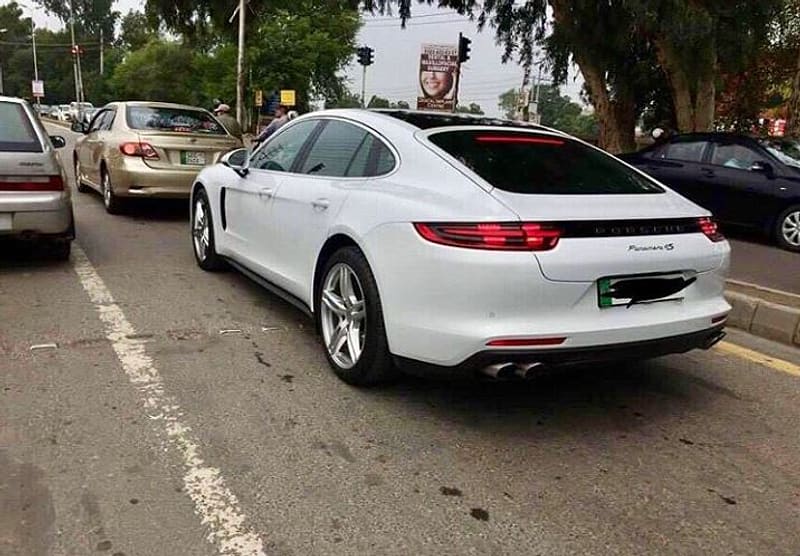
Lower and longer-looking than the 970: the roof falls away sooner, the hump is gone, and the tail has a slight counter-curve and sharper creases. Horizontal taillights with four-point LEDs are joined by a full-width light strip carrying the PORSCHE lettering. Non-Turbo cars have a one-piece rear spoiler. The Sport Turismo has a long roof with a prominent D-pillar and a moving roof spoiler; the Executive has longer rear doors and “executive” script. 2021-on cars have the Sport Design front with single-bar front light modules and a light strip that runs seamlessly across the tailgate; GTS models then got darkened taillights.

3 spots · Photos
Common

971 Panamera Turbo

2016–2020 · 542 hp

The second-generation Turbo, one of the two launch models: a new twin-turbo 4.0-liter V8 with 550 PS (542 hp) and 770 N·m (568 lb-ft), all-wheel drive, 0–60 mph in 3.4 seconds and 190 mph. It cost $146,900 in the US. In 2016 Porsche driver Lars Kern lapped the Nürburgring Nordschleife in 7:38 in a standard Panamera Turbo. It was sold as a sedan and a Sport Turismo until the 2020 update, when the Turbo S replaced it.

How to spot one

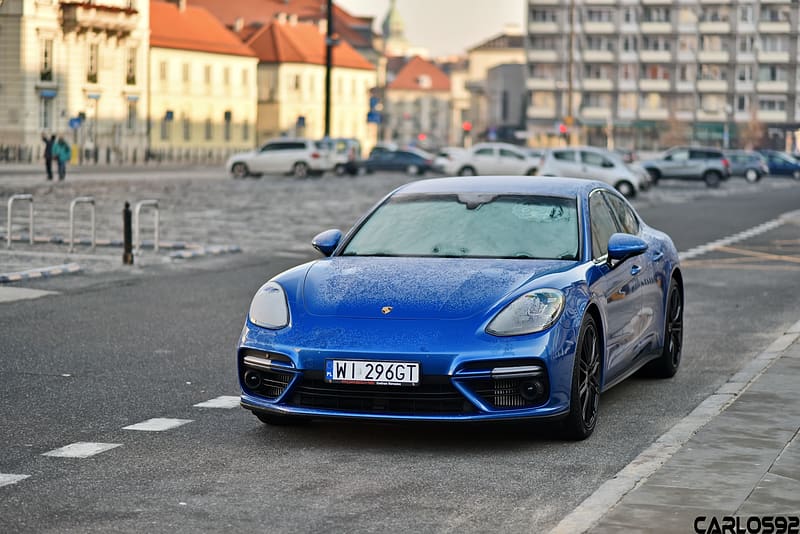
A front bumper with larger cooling intakes than the other trims and dual Turbo front light modules, a more sculpted rear bumper, and big wheels. The giveaway is the three-piece rear spoiler, which splits as it extends to add surface area (other 971s have a one-piece spoiler). Built only for 2017–2020, so it has the earlier light strip, not the seamless one of 2021-on cars.

1 spot · Photos
Not sorted yetIts spots are among the unsorted onesCommon

971 Panamera Turbo S

2020–2023 · 621 hp

With the 2020 update (2021 model year) the Turbo S replaced the Turbo: the 4.0-liter V8 went to 630 PS (621 hp) and 820 N·m (605 lb-ft), 80 PS more than the old Turbo, for 0–100 km/h in 3.1 seconds and 315 km/h (196 mph). A production Panamera driven by Lars Kern lapped the full 12.9-mile Nordschleife in 7:29.81, announced in August 2020 as the quickest executive car there; Porsche later named the car a Turbo S. The plug-in Turbo S E-Hybrid, first offered in 2017 with 680 PS (671 hp), returned in October 2020 with 700 PS (690 hp) and 870 N·m, 0–60 mph in 3.0 seconds and 196 mph. Both came as sedan, Executive and Sport Turismo.

How to spot one

Its own front end: larger side intakes, with body-color elements joined horizontally across the front, and the dual C-shaped Turbo light modules set further apart than on the earlier Turbo. The light strip runs seamlessly across the tailgate between new taillights. The Turbo S E-Hybrid has the same front.

Help sort them

976

2023–Present · 3 variants · 0 spots
Not sorted yetIts spots are among the unsorted onesCommon

976 Panamera

2023–Present · 348 hp

Every third-generation Panamera below the Turbo E-Hybrid. It was shown on November 24, 2023 as a sedan only; the Sport Turismo was dropped. The base Panamera (rear-wheel drive) and Panamera 4 (all-wheel drive) have a 2.9-liter twin-turbo V6 with 353 PS (348 hp). The plug-in 4 E-Hybrid (470 PS, 464 hp) and 4S E-Hybrid (544 PS, 537 hp) cost $117,495 and $128,795 with destination. The GTS, from 2024, has a V8 with 500 PS (493 hp), sits 10 mm lower and cost $156,195 (The Drive). Matrix LED headlights are standard and Porsche Active Ride suspension is available on the E-Hybrids.

How to spot one

Looks much like a late 971 sedan, with three tells: an extra air intake above the license plate, headlights set more steeply in the front with four-point daytime lights, and a frameless rear window, with the hatch blending into the C-pillars without a visible gap. A full-width light strip with illuminated PORSCHE lettering spans the tail. Base and Panamera 4 cars have one single tailpipe at each side; the GTS has black GTS logos on the sides and tail, red calipers and Dark Bronze tailpipes. No 976 is a Sport Turismo wagon.

Help sort them
Not sorted yetIts spots are among the unsorted onesCommon

976 Panamera Turbo E-Hybrid

2024–Present · 671 hp

The first Turbo of the third generation, on sale from 2024: a plug-in hybrid with a 4.0-liter twin-turbo V8 and an electric motor, 680 PS (671 hp) and 930 N·m (686 lb-ft) combined, 0–100 km/h in 3.2 seconds and 315 km/h (196 mph). It cost $192,995 in the US with destination.

How to spot one

Turbo models get their own front: side intakes that end level with the upper intake, vertical bars in body color and dark gray Turbonite air blades, plus Turbo front lights. Turbonite, a metallic gray reserved for the Turbos, also colors the Porsche crest on the hood, the side window strips and the “Turbo” script on the tailgate. At the back: a separate bumper with body-color diffuser panels and two double tailpipes in bronze.

Help sort them
Not sorted yetIts spots are among the unsorted onesCommon

976 Panamera Turbo S E-Hybrid

2024–Present · 771 hp

The most powerful Panamera so far, announced in July 2024: a 599 PS (591 hp) twin-turbo V8 and a 190 PS (187 hp) electric motor give 782 PS (771 hp) and 1,000 N·m combined, 0–60 mph in 2.8 seconds and 202 mph. Its battery holds 25.9 kWh (gross), and Porsche Active Ride suspension and carbon-ceramic brakes are standard. Days before its debut, Lars Kern lapped the Nürburgring Nordschleife in 7:24.17 in a pre-series car, 5.64 seconds quicker than the 971 Turbo S and a record for luxury cars with combustion or hybrid power. It started at $228,495 in the US.

How to spot one

The Turbo E-Hybrid’s body-color front, Turbonite trim and Turbonite “Turbo” script, plus yellow brake calipers (standard carbon-ceramic brakes), forged 21-inch center-lock Turbo S wheels in Turbonite and chrome tailpipes in Dark Bronze. An optional carbon Aerokit adds a Gurney flap to the four-way adaptive rear spoiler.

Help sort them

Tuner builds

8 variants · 31 spots
Uncommon

TechArt Panamera (GrandGT)

TechArt showed the GrandGT for the first Panamera at Auto Zurich in November 2010, after a Concept One at Geneva that March: a front bumper with a splitter, big intakes and LED daytime running lights, a carbon hood with vents, side skirts and flared fenders that widen the track 21 mm a side in front and 42 mm at the rear, a bigger roof spoiler and a diffuser rear bumper with oval twin tailpipes, on 20- to 22-inch wheels. Its TA 070/T1 kit takes the Panamera Turbo from 500 to 580 hp.

How to spot one

A first-generation Panamera with a deep front bumper with large intakes and LED strips, a carbon hood with vents, flared fenders, a large roof spoiler, oval twin tailpipes and TechArt wheels. Mansory's Panamera has more bare carbon and one center tailpipe; Hamann's Cyrano has a long nose and two big center tailpipes.

9 spots · Photos
Uncommon

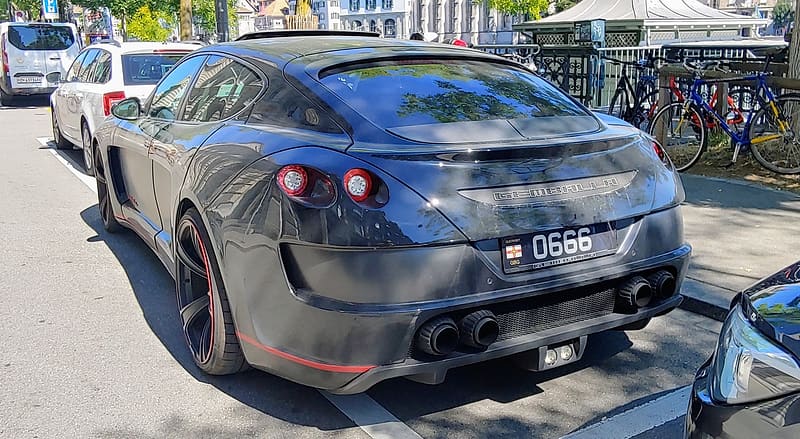
Gemballa Panamera (Mistrale)

Gemballa's Panamera, announced in August 2009 as the Panamera reached showrooms and shown at Top Marques Monaco and Dubai in 2011. A carbon-fiber body replaces everything but the roof and trunk lid: a new front with bigger intakes and vertical daytime running lights, a vented hood, front and rear fenders widened in the manner of the classic 911 over 22-inch forged wheels, and a rear bumper with a diffuser and four tailpipes. Engine stages for the Panamera Turbo gave 610 hp (850 Nm) and 700 hp (about 1,000 Nm); Gemballa first spoke of up to 750 hp.

How to spot one

A Panamera with flared, 911-style fenders front and rear, vertical LED running lights in a deep front bumper, a vented hood, a diffuser with four big tailpipes, and "GEMBALLA" on the tail. TechArt's Panamera (Grand GT) keeps the stock fenders.

1 spot · Photos
Uncommon

Lumma Panamera (CLR 700 GT)

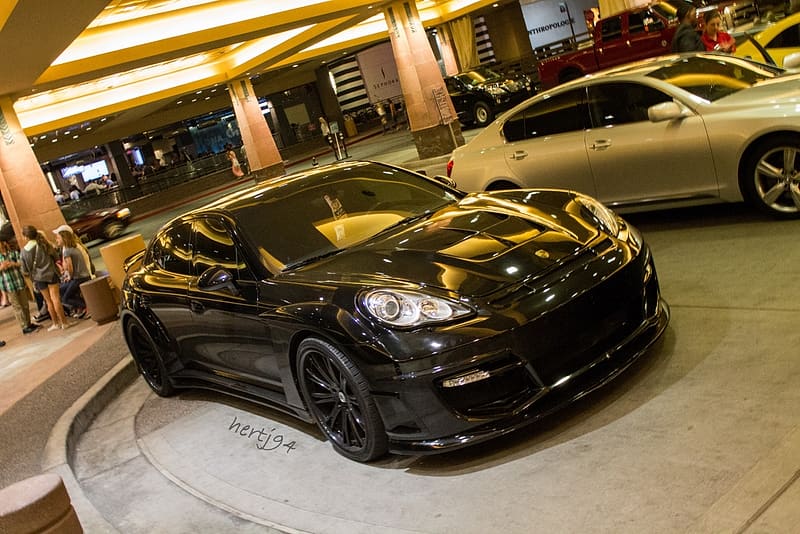
Lumma Design, a tuner in Winterlingen, Germany, sells its "CLR" body kits through dealers or from its own shop. The CLR 700 GT, shown as renderings in October 2009 and at the Geneva show in March 2010, is a first-generation Panamera with a carbon hood with two extra vents, a front spoiler with LED indicators, wider fenders, carbon side intakes and diffuser, a fixed rear wing on aluminum stilts and four 100 mm tailpipes, on 21-inch three-piece wheels. Lumma quoted up to 700 hp.

How to spot one

A first-generation Panamera with widened fenders, a vented carbon hood, a front spoiler with LED indicators, a fixed wing on stilts in place of the pop-up spoiler and four big tailpipes. A Mansory Panamera has more bare carbon and a single center exhaust; a Gemballa Mistrale has vertical running lights.

1 spot · Photos
Uncommon

Hamann Panamera (Cyrano)

603 hp

Hamann Motorsport, founded by Richard Hamann in 1986 in Laupheim, Germany, sells body kits, wheels, exhausts and engine work. The Cyrano (2011–12), named for its long nose, is a Panamera Turbo or Turbo S with a new front with bigger intakes and a new hood, fenders widened 60 mm, new side sills, a large rear spoiler and a diffuser with two big center tailpipes, on 22-inch "Gunmetal" wheels, 30 mm lower. The 4.8-liter twin-turbo V8 makes 603 hp: 0–62 mph in 3.7 seconds and 196 mph.

How to spot one

A first-generation Panamera with widened fenders, a long, reshaped nose with big intakes, a tall fixed rear spoiler and two big tailpipes in the middle of a diffuser. A Mansory Panamera has more bare carbon and one center exhaust; a Lumma CLR 700 GT has four tailpipes.

2 spots · Photos
Uncommon

Mansory Panamera

2010–Present · 681 hp

Mansory's kit for the first Panamera (970), shown in 2010 on a blue-and-yellow Panamera Turbo show car that Autogespot calls the "Panamera C One". A new front skirt with LED running lights, a carbon hood, wider fenders and doors, new side skirts, a big carbon diffuser with two exhausts in the center, and a carbon-covered or fixed carbon rear wing, on 22-inch forged turbine-design wheels. Bigger turbos, new engine software and a steel sports exhaust take the 4.8-liter V8 from 493 hp to 681 hp (690 PS): 0–62 mph in 4.0 seconds and 204 mph. The first customer car, also blue with yellow details, was seen in Baku in 2013.

How to spot one

A first-generation Panamera (2009–16) with fender flares front and rear, a bare-carbon hood, LED strips in a deep front bumper, a carbon diffuser with the tailpipes in the middle (a stock Panamera has them at the corners) and often a fixed carbon wing instead of the pop-up spoiler; turbine-blade wheels. Gemballa's Mistrale has vertical running lights and four tailpipes.

10 spots · Photos
Uncommon

Wald Panamera (Black Bison)

2012

Wald International (WALD Co., Ltd., Takatsuki, Osaka, Japan) grew out of a Mercedes-Benz tuning shop opened in 1990. Its Black Bison kit for the first-generation Panamera, reported in January 2012 and sold as the “Sports Line Black Bison Edition,” adds a front bumper with large sculpted air intakes, grilled vents in the front fenders, side skirts, flares on the rear fenders, a trunk-lid spoiler and a rear bumper with a diffuser. Wald also offered a lowered suspension, its “D.T.M.” exhaust tips, tinted headlights and wheels: two-tone five-spoke rims on the demo car, or its matte black multi-piece Mahora 13 in 22 or 24 inches. Wald had no German dealer; Europeans bought through partners in the UK and Finland.

How to spot one

A 970 Panamera with a deep front bumper with large angular intakes, grilled vents in the front fenders, side skirts, flared rear fenders, a spoiler on the hatch, a rear diffuser with Wald tailpipes, and a low stance on 22–24-inch wheels.

4 spots · Photos
Uncommon

FAB Design Panamera

2009–2010 · 15 built

Swiss tuner FAB Design of Mellingen showed its widebody Panamera Turbo in December 2009, at the Dubai Motor Show. The body is 16 cm wider than stock, with new front fenders and rear haunches that run forward into the rear doors, a new front with big intakes and a full-width front spoiler, a carbon “boomerang” piece ahead of each front wheel, matching side skirts, a carbon hood, an aircraft-inspired rear wing and a diffuser with three trapezoid tailpipes in the center. It rides about 20 mm lower on three-piece 22-inch wheels, with bigger brakes. FAB said the 4.8-liter Turbo V8 would make up to 700 PS; Auto Bild’s 2010 test car had 580 PS. evo reported 15 would be made.

How to spot one

A 970 Panamera much wider than stock, with fat rear fenders that start in the rear doors, carbon trim ahead of the front wheels, a large rear wing and three trapezoid tailpipes grouped in the middle of the diffuser instead of Porsche’s pipes at each side.

3 spots · Photos
Uncommon

SpeedART Panamera (PS9)

2009 · 650 hp

SpeedART showed its PS9 program for the first Panamera Turbo at the Essen Motor Show in late 2009. Power kits ran from 520 to 650 hp (as quoted); the 600 and 650 hp kits added bigger turbochargers and intercoolers, and the 650 hp car had 890 N·m (656 lb-ft), 0–62 mph in 3.5 seconds and over 200 mph. The PS9 body kit adds a front chin spoiler with brake-cooling ducts, hood vents, side skirts, a rear bumper with side air outlets, a diffuser and a spoiler on the hatch, with a sport exhaust with a sound switch and polished or matte black tailpipes. Wheels are SpeedART three-piece forged 22-inch rims with a 23-inch center star, on 265/35 and 305/25 tires.

How to spot one

A 970 Panamera Turbo with a chin spoiler, vents in the hood, side skirts, air outlets at the rear bumper corners, a diffuser and a spoiler on the hatch, on three-piece 22-inch wheels.

1 spot · Photos

Body kits and one-offs

1 variant · 1 spot
Uncommon

Modified Panamera

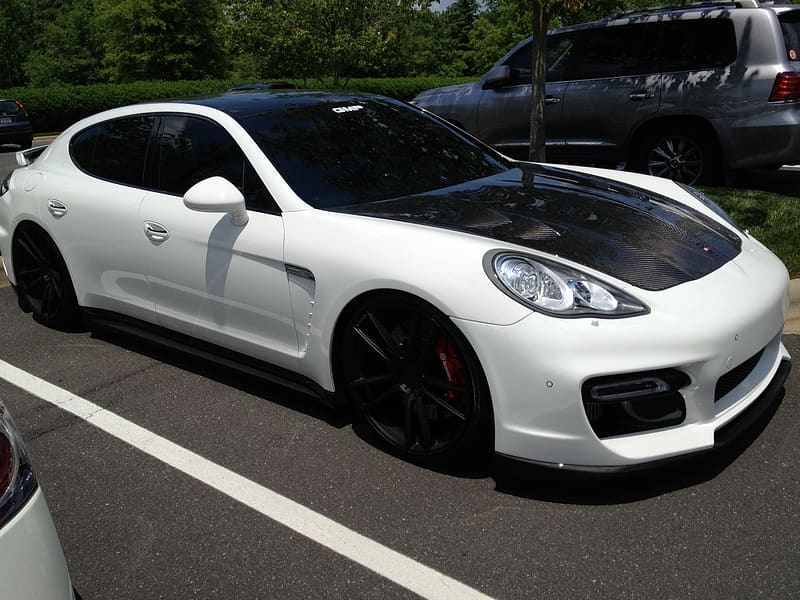
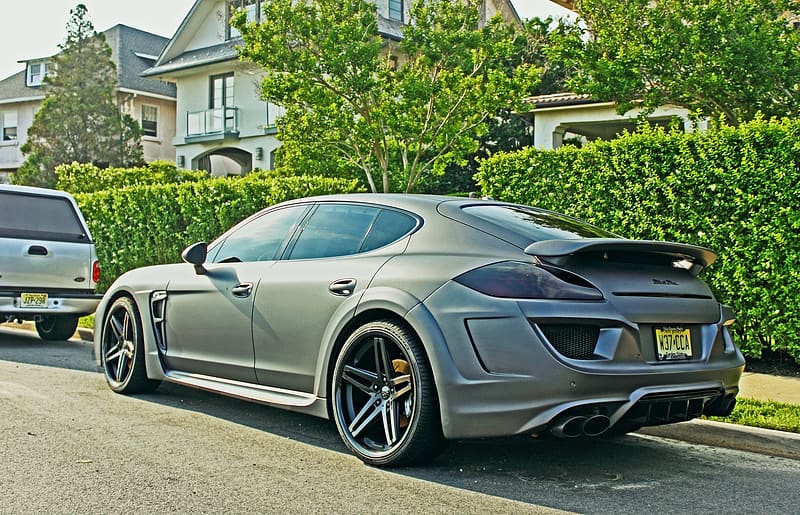
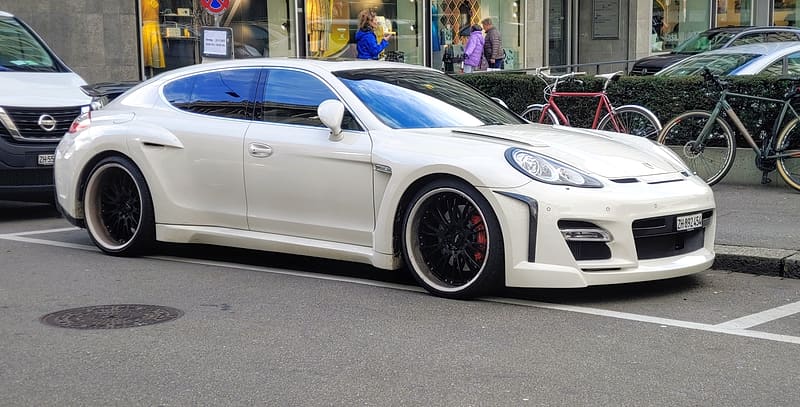
Panameras with body kits, one-off liveries or other big changes that no other version covers.

How to spot one

Anything far from factory looks; wraps and aftermarket wheels alone don’t count.

1 spot · Photos

8 Panamera spots need a variant

Most spotters just write “Panamera”, and nothing in these descriptions tells the variant. Open one and say which it is: when three spotters agree, the spot gets its variant.

41 of 49 sorted (84%)
Help sort 8