Caterham Seven

The Lotus Seven carried on since 1973: a tiny open two-seater in kit or factory-built form, from 84 to 310 hp.

Common· 10 pts1973–PresentIn production5 variants
Caterham Seven
Years1973–PresentIn production
Power84–310 hpBy version
0–60 mph2.8 sQuickest version
On ExoticSpotter76 spotters · 5 places

Every Seven

5 variants, by generation: what each one is, and how to tell it apart on the street.

Production cars

1973–Present · 5 variants · 7 spots
Common

Seven 170Standard

84 hp

Caterham’s entry-level Seven since 2021, replacing the 160 and 165. It uses a turbocharged 660 cc Suzuki R06A three-cylinder from a Japanese kei car, with 84 hp, a Suzuki gearbox and a live rear axle, and at 440 kg it is the lightest production Seven Caterham has built. It comes only on the narrow Series 3 chassis and is small enough to count as a kei car in Japan.

How to spot one

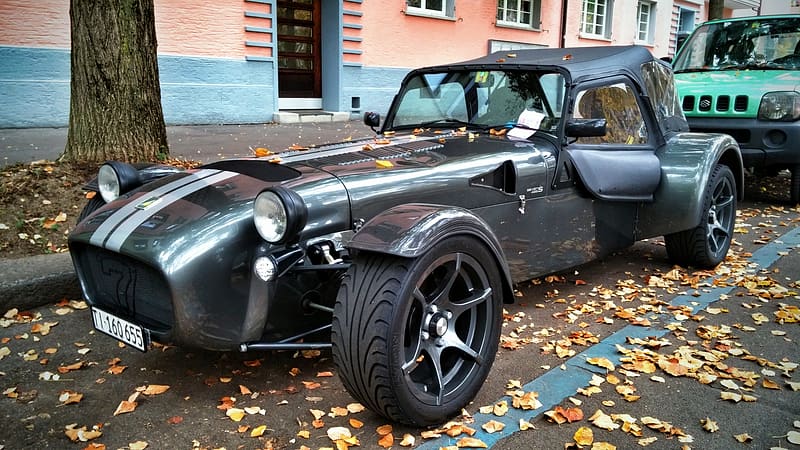
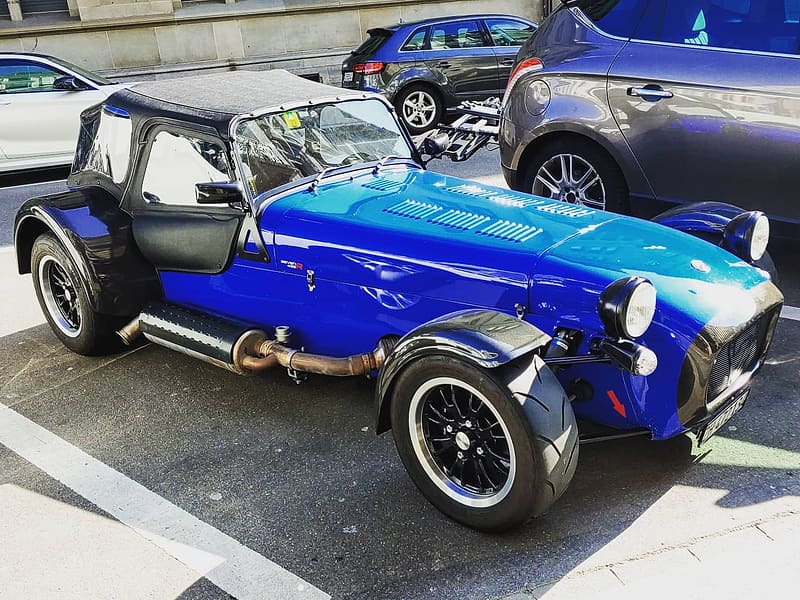
It has narrower front and rear bodywork and skinnier tires than the 2.0-liter Sevens.

7 spots · Photos
Not spotted yetBe the firstCommon

Seven 360

180 hp

Part of the numbered range Caterham adopted in 2015, in which the number reflects the power-to-weight ratio in horsepower per tonne. The 360 has a 180-hp 2.0-liter Ford Duratec four, a 5-speed manual and a de Dion rear axle, weighs about 560 kg and reaches 60 mph in 4.8 seconds and 130 mph flat out. It is sold as a kit or factory-built, on the narrow S3 or wider SV chassis, with road (S) or track (R) packs.

Be the first to spot one
Not spotted yetBe the firstCommon

Seven 420

210 hp

The middle of the Seven range, with a 210-hp naturally aspirated 2.0-liter Ford Duratec and a 5-speed manual in a car of about 560 kg, good for 0–60 mph in 3.8 seconds and 136 mph. Like the 360 it comes as a kit or factory-built, in S3 or SV chassis sizes, with S or R packs. The 420 Cup is a more track-focused but still street-legal version with a six-speed sequential Sadev gearbox and adjustable Bilstein dampers.

Be the first to spot one
Not spotted yetBe the firstCommon

Seven 620

310 hp

The fastest car in the current Seven range, sold only factory-built. A supercharged 2.0-liter Ford Duratec makes 310 hp, and in R form, with a 6-speed sequential gearbox, it reaches 60 mph in 2.79 seconds and tops out at 149 mph. It grew out of the 620R of 2013, a supercharged development of the R500.

Be the first to spot one
Not spotted yetBe the firstRare

Superlight R500

230 hp

The most extreme Seven of its day: Rover’s 1.8-liter K-series, tuned by Minister Racing Engines to about 230 hp at 8,600 rpm, in a car weighing just 460 kg. It was first offered as a kit but soon became factory-built only, and its engine needed frequent rebuilds. The 250-hp 2.0-liter R500 Evolution of 2004 set a 0–100–0 mph record of 10.73 seconds, and from 2008 the R500 name passed to a 263-hp Ford Duratec car that Top Gear made its 2008 Car of the Year.

How to spot one

Like other Superlights it usually has carbon-fiber front wings and nosecone, no spare wheel on the back and often an aero screen in place of the windshield.

Be the first to spot one